

Logitech Powerplay review: Wireless-charging mouse pad will make you a believer - bauerbessuchim40
I've been converted. I never thought I'd atomic number 4 a wireless-mouse fan—first because wireless performance always lagged behind that of a wired mouse, then later because I was too lazy to periodically charge the damn thing. I could see the benefits of a wireless headset and could realise charging one of those part of my daily routine. Simply a little cord drag on a mouse seemed a elflike price to invite convenience.
And yet here we are. Logitech's newfound Powerplay technology, centered on a mouse pad that charges your tune mouse piece you're using it, has made me a wireless believer.
I mightiness ne'er go back.
This look back is set out of our roundupof best g aming mice. Go there for details on competing products and how we tried and true them.
Cord cutter
Powerplay is a two-part scheme: the aforementioned mouse pad and so (at the moment) single of two compatible mice to slip by with information technology. Those mice, the G703 and G903, john be victimised independent of the Powerplay mouse inking pad, as just your everyday lithium-ion power-driven wireless mice, complete with a corduroy you need to sporadically plug in for recharging. Thusly I might mention them off-the-cuff, but for the sake of clarity I'm going to focus primarily on the mouse pad here. Feel free to cheque our full reviews of the dextral G703 and ambidextrous G903 though.
 IDG / Hayden Dingman
 I keep referring to "the mouse pad" but I speculation I should start up aside noting that information technology's a little more complicated than IT sounds. There are triplet components, actually—four if you count the bit that plugs into the mouse. (More on that later.)
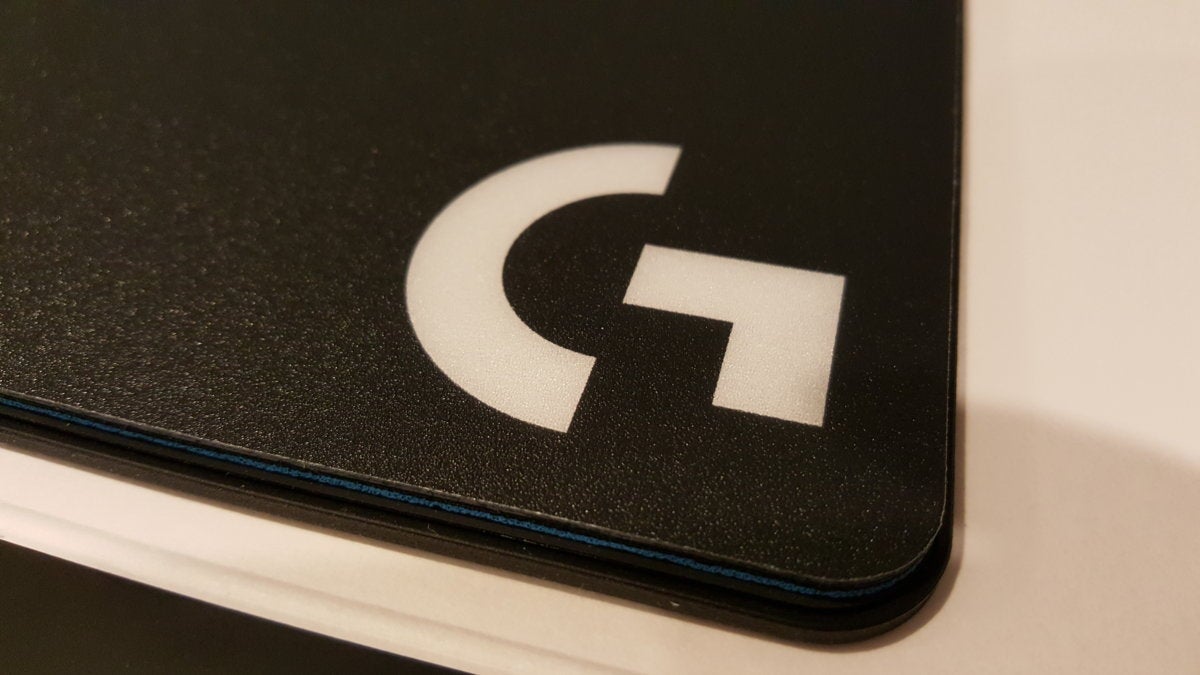
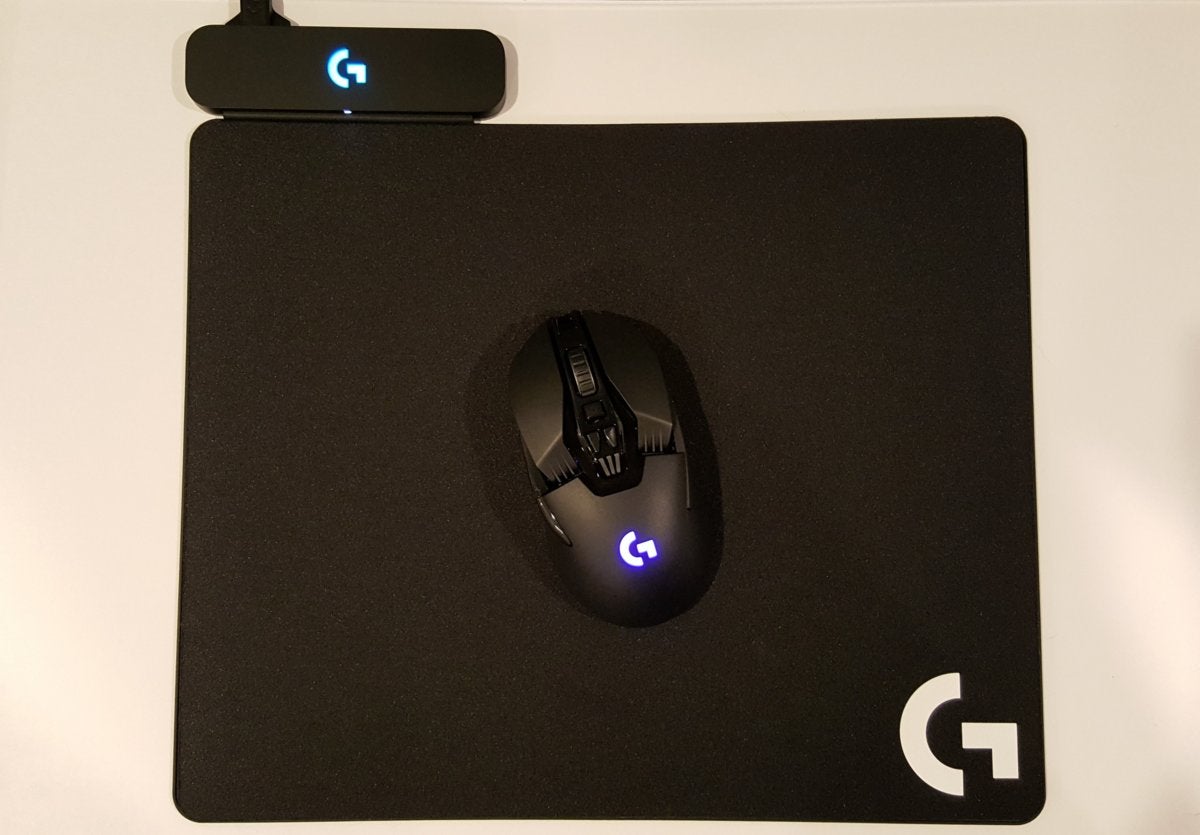
The Powerplay base is the core technology, and the part you plug into your PC. It looks quite a a bit like Razer and Barbary pirate's recent RGB mousepads—a semi-stiff piece of plastic, measuring approximately 12×13 inches, with a thicker hub in the high-left corner where the USB cable connects to your computer.
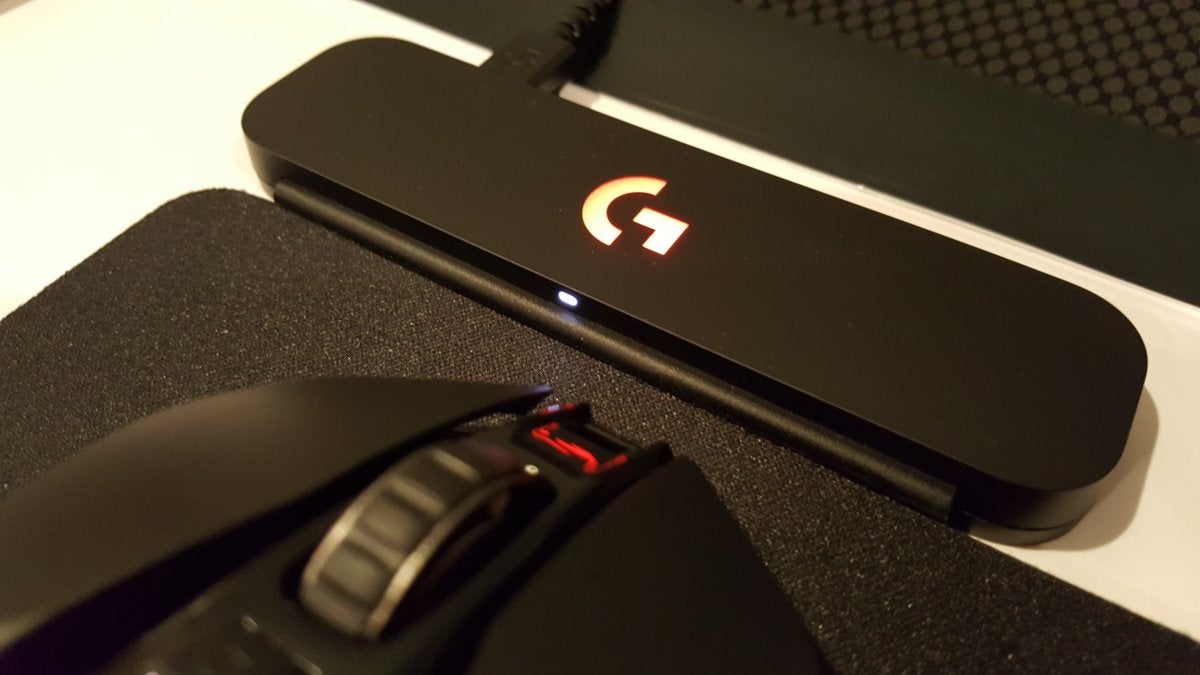
Plug it in and you might suppose, "That's it?" A a man-to-man Logitech "G" logo on that hub is illuminated. It's a far cry out from the decadent rings of RGB lighting that festoonery the Razer Firefly and Corsair MM800 Polaris.
 IDG / Hayden Dingman
 Patc RGB mousepads take up always seemed like a bizarre (albeit "cool") proposition—almost $100 for some lights, basically—Powerplay is actually functional. When you hype IT in, the mouse pad generates an electromagnetic branch of knowledg across most of the base. This field projects few millimeters above the pad, which is where components two and triplet move into—a twin of alternative surfaces, one material and one hard plastic, mimicking much traditional shiner pads.
I've been using the cloth surface. Hard surfaces have less clash, which can constitute better for rapid movements and put across inferior strain on your radiocarpal joint, but…fortunate, I just favour textile. It's softer, information technology's quieter, and it's (marginally) Thomas More precise. It's at long las a matter of personal preference, and therefore smart of Logitech to include both options.
Whichever you choose, you simply set it down atop the base. The base is rubberized, soh your chosen surface shouldn't slip around—I've tried, and at least with the material, it's beautiful much impossible nether normal conditions.
The last piece of the puzzle then is the "Powercore Module," or the bit that actually transfers the explosive charge from the mousepad to the mouse. This is a slick bit of engineering, as I've get along to expect from Logitech lately.
 IDG / Hayden Dingman
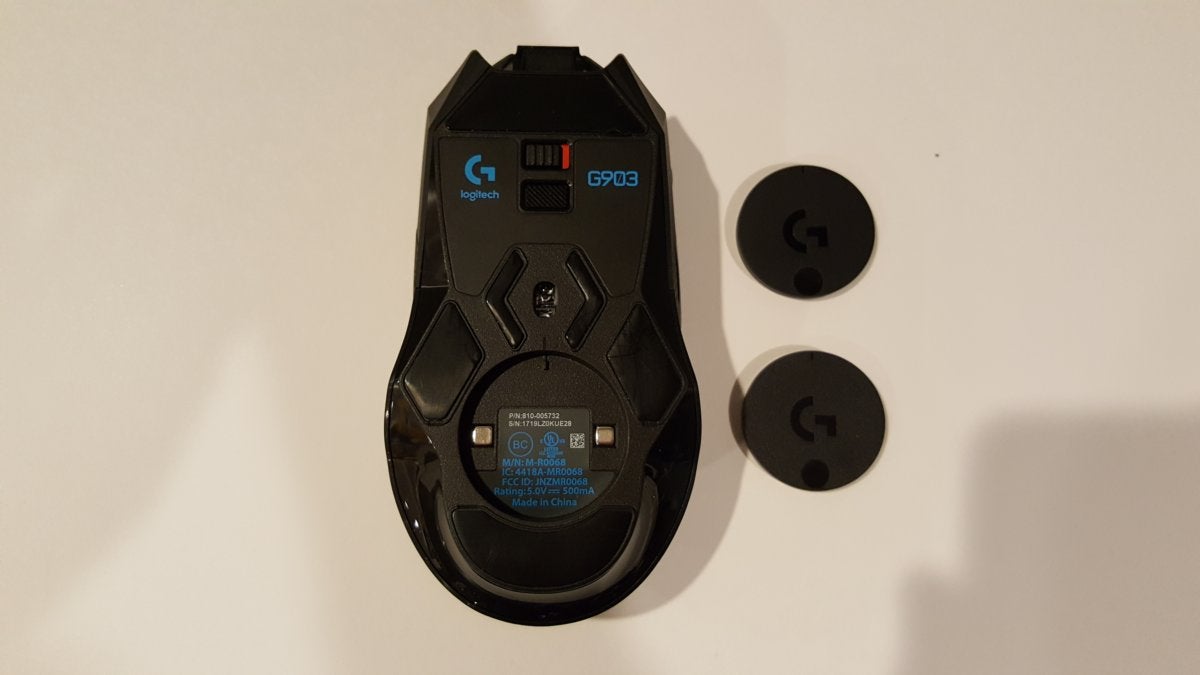
 Some the G703 and G903 transport with a unimportant plastic disc magnetically attached to the bottom. Sans-Powerplay, this plastic disc can either live left in place or, if you prefer a heavier computer mouse, swapped out for a similar disc with an embedded 10-gram weightiness.
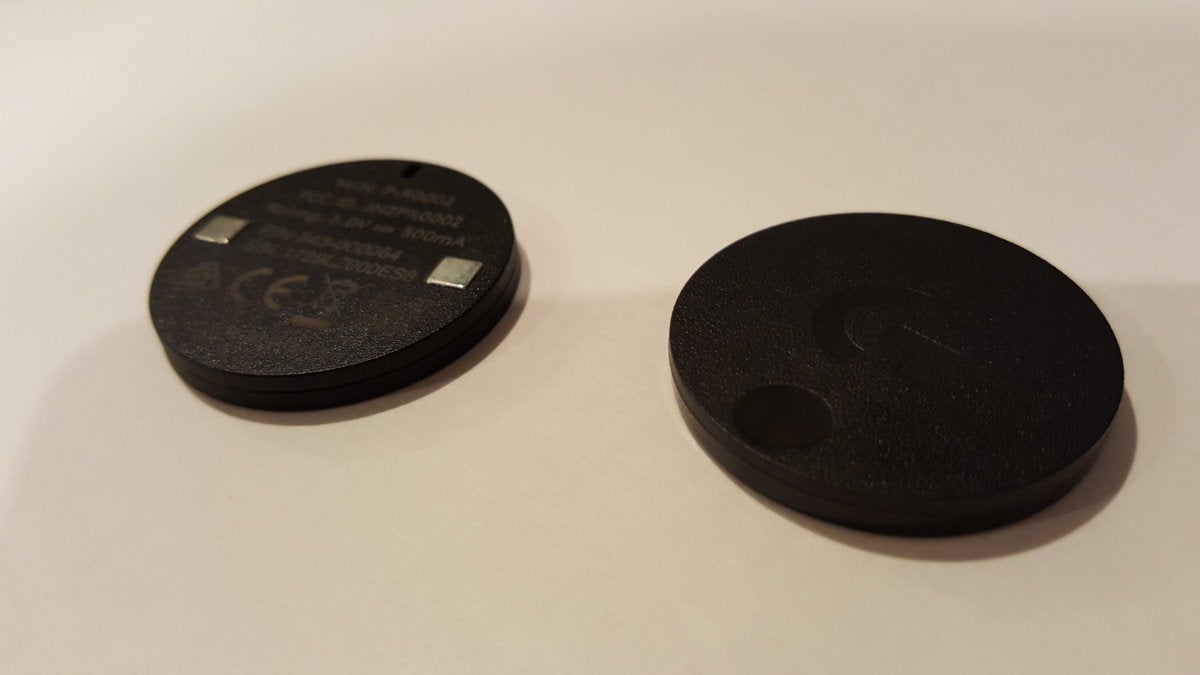
Powerplay simply fills this same muddle with the same Powercore, some other fleck of fictile with a pair of visible metal contacts. Remove the stock plastic bit, slap the magnetic Powercore in, and voila—you have a Powerplay-ready G703 or G903. If you have both mice on hand for some reason, changing between the two is as easy as pulling the Powercore out and transferring it to the other mouse, and so using Logitech's software to geminate the favourite device.
Once the base is blocked in, your chosen mouse pad surface is applied, and Powercore is inserted, that's it. You're at the ready to go. The wireless receiver for the G703 or G903 is embedded in the Powerplay base, so there's no need for a second dongle. You don't even pauperism to copulate the mouse manually the first meter—whichever one you power on and coif along the mouse pad, works.
 IDG / Hayden Dingman
 And it real works. I've been victimisation Powerplay for near a month now. When my review kit showed up, the G903 had around a 20 percent charge. It hasn't died happening me since, nor take over I ever plugged it in.
Logitech claims you'll pay off 1 or 2 percent shoot per hour when the mouse is in use, or a full charge in 12 about hours if the sneak is idle. Those figures obviously pale in compare to cable system charging—you can get a full G903 charge in as little as two or ternary hours if plugged in.
What Powerplay offers though is true fire-and-blank out wireless. Gravely: You just forget it's wireless. As I said, I've been exploitation the G903 for around a month now. It's never died on me mid-match. It's never died along me period. I've ne'er gone to sleep late at Night and thought, "Oh crap, I postulate to walk second to my computer and fireplug in my mouse."
Nope. As advertised, the G903 has cycled betwixt 80 and 95 percent battery, discharging and recharging to keep the battery healthy but otherwise staying "full charged." After about a week you stop thinking well-nig it.
And it's successful me a believer. "It's not a loud lot to connect a mouse all night to charge," you might say, and you're right! It isn't a big lot. Not in truth. The convenience of never having to think about it though? I can't overstate it. Antecedently, a wireless mouse was a cool product that I found myself intermittently annoyed by. With Powerplay, a radiocommunication mouse is just a wired sneak without the electrify. No trade-soured, no compromises.
It helps that Logitech's wireless mice are damn good, as well. They wake and are ready to go within milliseconds of being shaken, and I've never noticed a single bumble or even a hint of interference (in my signal-noisy city apartment). Like many gamers I'm traditionally disbelieving of wireless mice, but Logitech's shaken me of those concerns.
Wallet strainer
The only caveat is that Powerplay is expensive. The Powerplay base is $100 with the included mouse pad surfaces and the Powercore. As if that wasn't repentant enough, the G703 bequeath run you another $100; the G903 an eye-watering $150. That means you're looking at $200 to $250 for the convenience of not having to connect your mouse at night.
A demanding sell, right?
 IDG / Hayden Dingman
 There's also that whole "proprietary technology" thing. Consumers are increasingly getting locked in to their brand choices. First IT was incompatible RGB lighting Apis pushing people to buy a matching suite of peripherals, now it's a mouse pad that only whole works with certain mice. I'm non looking wise to another fractured peripherals landscape as each manufacturer rolls out a version of Powerplay in the close a couple of years—Corsair's is already proclaimed, and patc information technology uses the open Qi standardised, information technology won't be compatible with Logitech's tech.
So once you buy Powerplay, you'd break desire you wish to use Logitech mice for the rest of your life (and that the tech keeps being supported), other you're looking a useless hunk of plastic. Heck, I've exploited a Logitech black eye day-to-day for going connected trine years and I'm still feeling let down. There's none Powerplay-ready version of the G502 yet, and while the G903 is an excellent mouse information technology isn't quite a as comfortable.
Dear. Proprietary. Narrow choices. These are whol real hurdles for Logitech to overcome.
Bottom line
That being said, Powerplay is incomparable of the just about forward-thinking technologies I've seen in years. Logitech's been pushing wireless hard for a patc now, with better batteries, better sensors, better response times, etcetera. Powerplay feels like the last piece of the puzzle over, the tipping steer where radio in truth starts to supervene upon wired.
Quintuplet years ago, I would've sworn wired would forever beat wireless. Now I'm not so sure. Give information technology 10 or 15 years and a couple of price drops and the wired mouse power be as antiquated as the connected gamepad. Never underestimate convenience.

Source: https://www.pcworld.com/article/407423/logitech-powerplay-review-wireless-charging-mouse-pad.html
Posted by: bauerbessuchim40.blogspot.com
0 Response to "Logitech Powerplay review: Wireless-charging mouse pad will make you a believer - bauerbessuchim40"
Post a Comment